How to Sell More High-End Countertop Projects with a Better Quoting Experience
A practical guide to winning premium homeowners and designers with consultative sales, detailed digital proposals, and controlled quote revisions.
Updated October 4, 2026
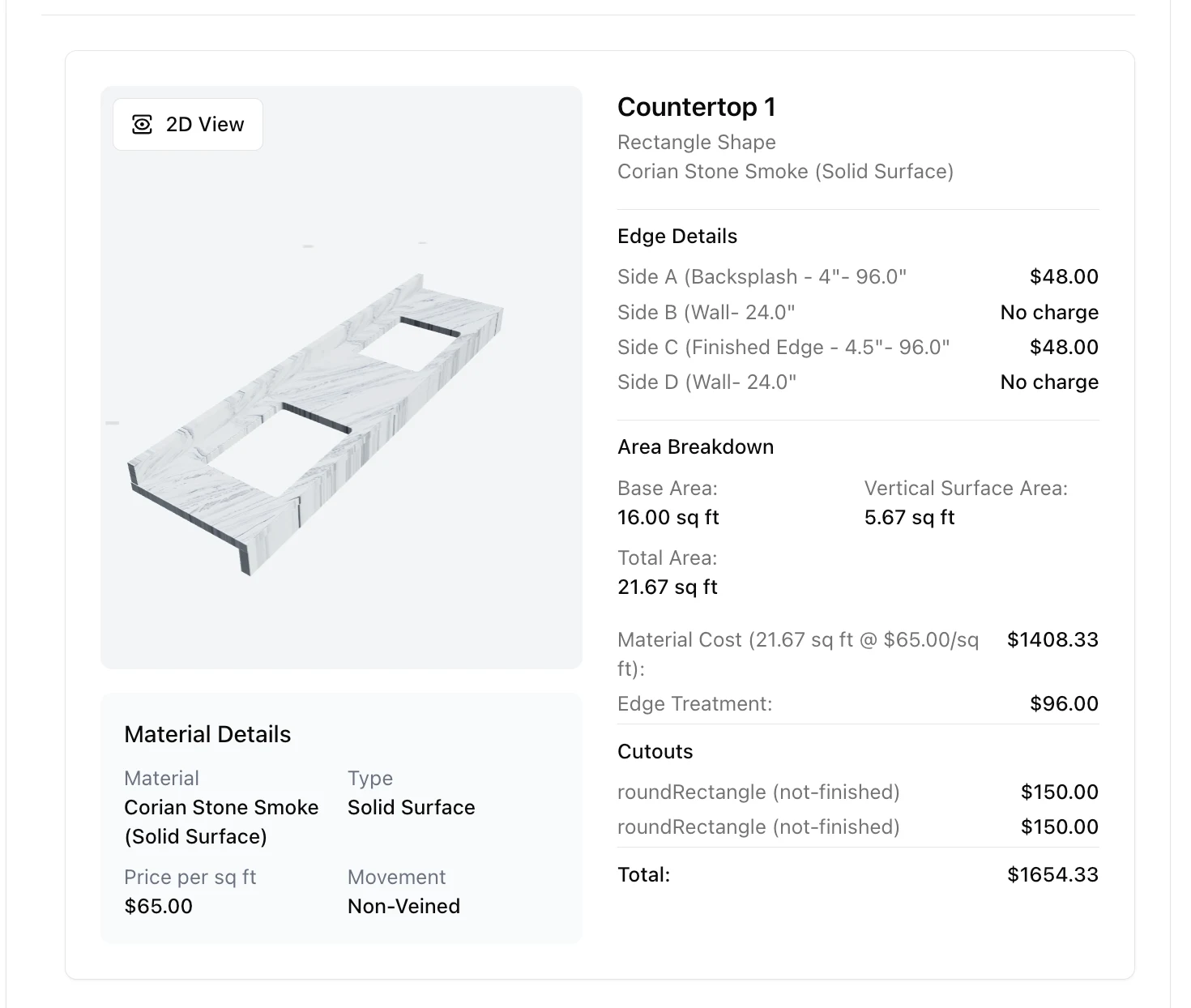
Premium homeowners, architects, and interior designers are not simply buying stone by the square foot. They are buying confidence that the finished work will respect the design, that difficult details will be handled carefully, and that every decision will remain organized from proposal through fabrication. Your quoting process is one of the first places they decide whether your company can deliver that experience.
Sales software can make that process more consistent, but the software is not the strategy. The goal is to combine design fluency, thoughtful discovery, a thorough proposal, and controlled revision handling into one professional buying experience.
High-end clients buy certainty before they buy stone
A price-first quote answers, “What will this cost?” A premium proposal also answers the questions that create confidence:
- Did the fabricator understand the designer's intent?
- Are the material, finish, edge, seam, cutout, backsplash, and installation assumptions visible?
- Can the client compare options without rebuilding the entire conversation?
- Will everyone know which revision was approved?
- Can the approved scope move cleanly into templating and production?
When your proposal resolves those concerns, the conversation becomes less about defending a number and more about demonstrating how the project will be managed.
Build relationships with designers before asking for projects
Designers remember fabricators who make their work easier. Lead with useful collaboration rather than a generic request for referrals. Learn the designer's preferred materials, typical project type, presentation style, approval process, and common pain points. Ask how they want allowances, alternates, and client-facing selections displayed.
A strong first meeting can focus on a real project or sample drawing. Show how you would identify scope questions, organize premium options, document assumptions, and return a polished proposal. This gives the designer evidence of your process without relying on broad claims.
Questions that signal a consultative sales process
- Which visual details are essential to the concept, and which are flexible?
- Are there material alternates the client should compare?
- Which edges, seams, overhangs, backsplashes, or waterfalls need explicit review?
- Who provides final approval: the homeowner, designer, builder, or a combination?
- How should revisions be labeled and shared with the project team?
Turn the quote into a guided design decision
A high-end proposal should be thorough without becoming difficult to read. Start with a concise project summary, then organize the detail so a client can move from the overall vision to the exact scope.
A premium quote can include
- Project areas and clearly separated surfaces
- Selected material, finish, thickness, and relevant pattern direction
- Edge profiles, cutouts, backsplashes, waterfalls, and specialty details
- Drawings or 3D visuals that clarify what the words and line items describe
- Base scope, alternates, upgrades, allowances, and exclusions
- Template, fabrication, delivery, installation, and approval assumptions
- A revision number, date, status, and clear next action
The goal is not to overwhelm the buyer with technical information. It is to reveal the information that matters at the moment a decision is being made.
Use automated revision handling as part of the sales experience
Premium projects evolve. A homeowner upgrades the island material. A designer changes the edge treatment. A builder adjusts a wall. Revision handling becomes a competitive advantage when each change feels controlled rather than chaotic.
When evaluating sales software, look for a connected quoting workflow that preserves the prior version, carries forward unchanged scope, updates affected line items, recalculates the price, and issues a clearly numbered revision. The client should be able to see what changed and which version is awaiting approval. Internally, the sales and production teams should be able to trace the approved scope without searching through email attachments.
A disciplined revision workflow
- Capture the request. Record who requested the change, what changed, and the reason or design context.
- Create a new version. Preserve the prior quote instead of overwriting the record the customer already reviewed.
- Update only the affected scope. Carry forward approved details and recalculate the material, fabrication, installation, or option changes.
- Summarize the difference. Tell the customer what changed in plain language; do not make them compare two long PDFs line by line.
- Request approval on the current version. Make the revision number and status unmistakable.
- Lock the accepted scope into the job record. Give estimating, templating, fabrication, and installation one approved source of truth.
Sell value without making unsupported promises
A premium presentation should not depend on vague claims such as “best quality” or guaranteed savings. Show the quality of the process instead. Use representative drawings, explain how unusual details are reviewed, identify assumptions, and demonstrate how revisions and approvals are recorded.
This evidence is especially useful with designers. It shows that your team can protect design intent while also controlling the practical handoff into fabrication.
Measure the sales process, not just the final close
Track where premium opportunities slow down. Useful measures include time to first proposal, number and reason for revisions, time awaiting customer approval, option selection patterns, and the point where a prospect disengages. Review those patterns by project type and referral source rather than assuming every lead follows the same path.
The purpose is not to pressure the customer. It is to remove avoidable uncertainty and help the right clients make informed decisions.
A better quote becomes part of your brand
High-end clients and designers notice how a company communicates. A proposal that is visually clear, technically thorough, easy to revise, and simple to approve demonstrates the same care they expect in the finished installation.
Explore how 2cm.ai connects takeoff, quoting, customer presentation, approvals, and project information, or bring a representative drawing to a demo and review how your current sales process could be organized.
Use the proposal to resolve one decision at a time
In a design review, ask the customer to confirm the material, edge, sink configuration, and installation scope separately. A change from one material to another may affect the proposal even when the drawing stays the same. Put the revised scope and price in the customer’s hands before asking for approval.
The 2cm customer quote brings a design preview and itemized pricing together. Treat the rendering as a design aid; confirm the actual slab and final field dimensions through your shop’s normal process. For the next handoff, use the project workspace to coordinate the approved job.