What to Look for in an AI-Assisted Countertop Quoting System
Evaluate the path from plan interpretation to reviewed quantities, shop pricing, and a customer-ready quote.
Updated October 20, 2026
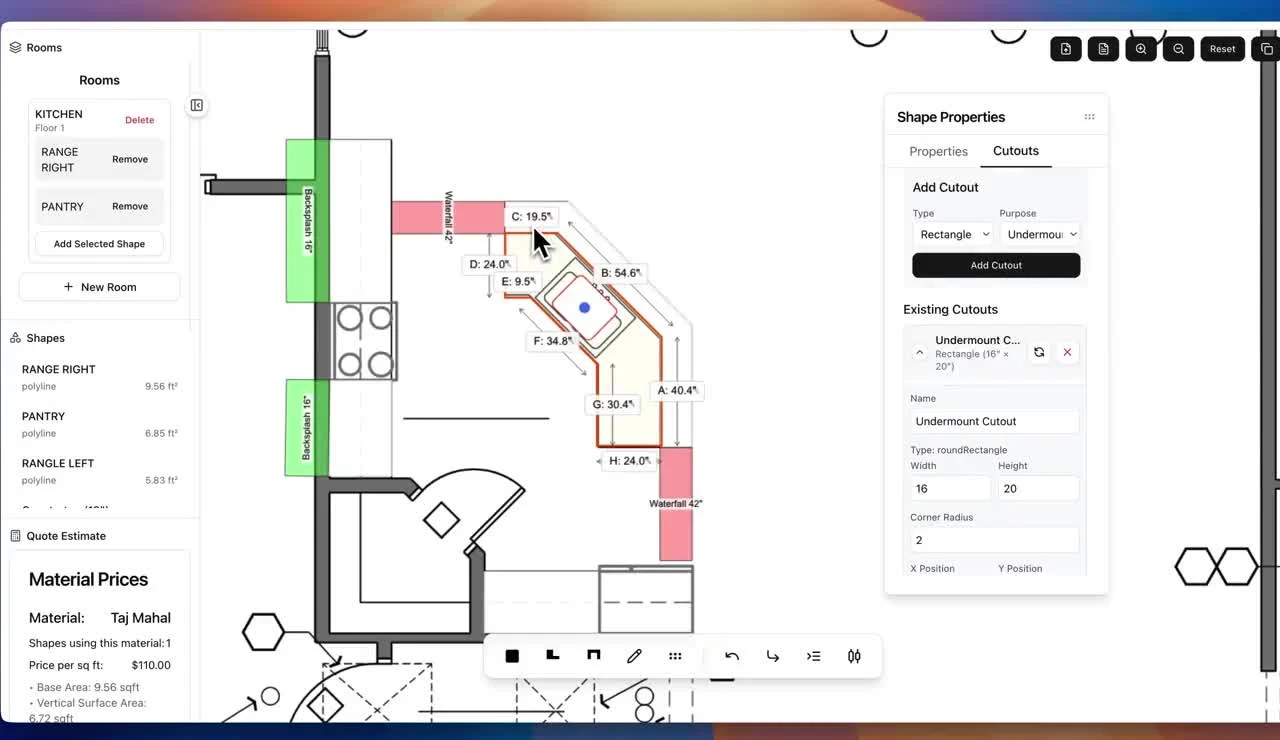
A quote needs more than recognition
Interpreting a drawing is one part of estimating. The quote also needs the selected material, fabrication details, installation scope, rates, and assumptions. Evaluate how a system brings these pieces together.
Use a completed job as a reference. You should be able to trace the proposed price back to the work that was identified and the rules your shop uses.
Make review part of the workflow
An estimator should be able to inspect dimensions and geometry, correct the interpretation, and add missing details. Review becomes especially important when a plan is scanned, incomplete, or ambiguous.
Check a known dimension before relying on the drawing scale. Confirm cutouts, finished edges, and splashes against the actual scope.
Bring your pricing rules
Test the rates your team actually uses for materials, edges, cutouts, fabrication, and services. Ask how minimums and exceptions are represented and who can change the configuration.
The useful result is a proposal your estimator can explain. Review the line items before the customer sees them.
Try a revision before deciding
Change the material, adjust an island, or add a splash. Follow that change through quantities, pricing, visualization, and the customer proposal.
This reveals whether the workflow keeps context or asks the estimator to rebuild the job. It also helps identify the checks your team needs before sending a revised quote.
Evaluate the customer handoff
Show the quote to someone who was not involved in creating it. Can they understand the selected option, included work, and next action? A clear presentation is part of a complete quoting process.
Bring a plan and price sheet to a 2cm demo to follow the takeoff, material selection, design review, and itemized proposal together.
A repeatable demo job
Bring one completed job with its source plan, selected material, edge details, cutouts, and approved estimate. Recreate the takeoff, compare the quantities, and check how the system applies your material and fabrication rates. Investigate a difference line by line rather than comparing only the totals.
Then change one input, such as the material or an edge treatment. Check how the proposal changes and what the customer sees. This is an evaluation exercise, not a claimed accuracy benchmark. See the takeoff workflow and AI-assisted countertop quoting software to plan a representative demo. Follow the four quoting steps, then inspect the actual automatic nesting example.